


By Jasmine Durst; Photo Credits to Jasmine Durst
Burning the first draft of your essay creates room for a better second draft.
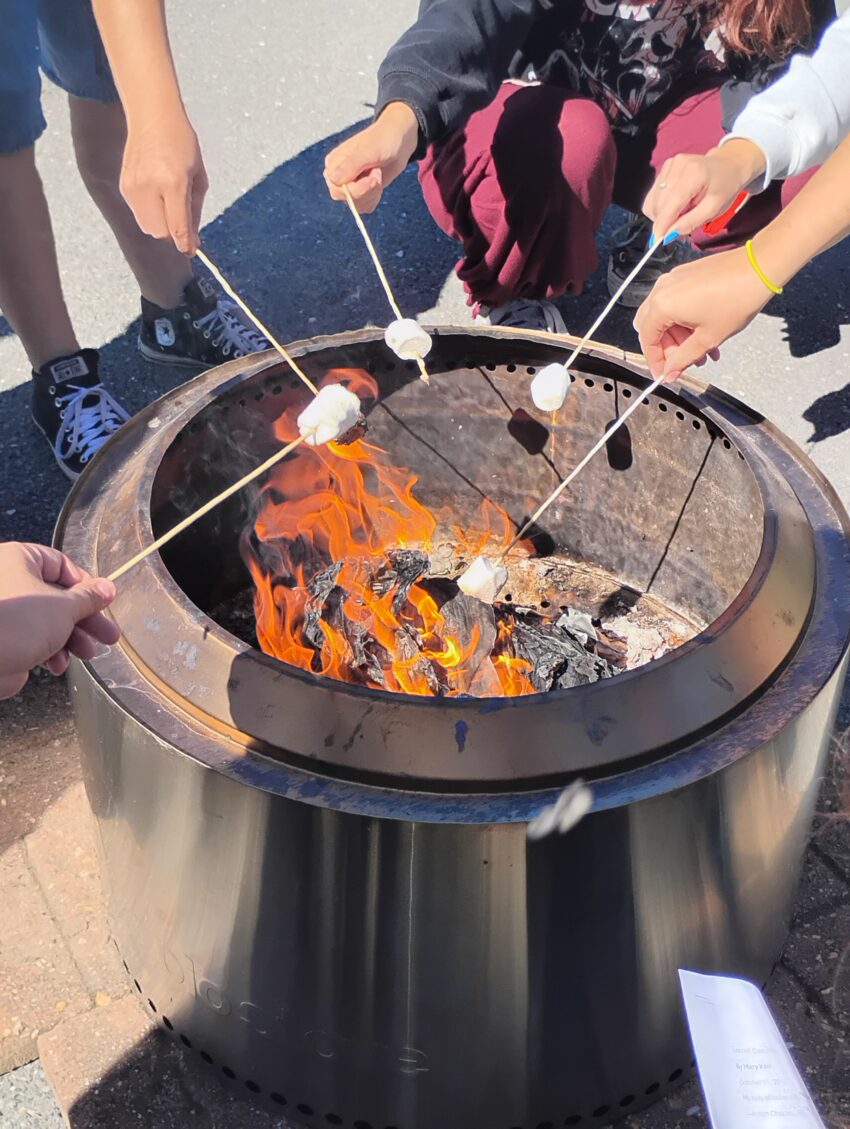
Susquehanna University’s Intermediate Creative Nonfiction class burned the first draft of their essays on Tuesday, Sept. 15, 2026, in the back parking lot of the Writers Institute during class.
Professor Sean Ironman and his 12 students participated in the burning with several other creative writing students and professors joining them to watch.
Facilities brought a metal firepit with a lid to contain the fire, and one stayed to supervise in case anything went wrong while Professor Tony Zitta started the fire for the students with a match, cardboard, and stray mail envelopes.
At the beginning of the semester, the Intermediate Creative Nonfiction students were tasked by Ironman to write 10 pages, all front and back, or write 200 index cards as their first draft.
Ironman said, “The only words that matter are in the final draft. Until then, the importance lies in the writer thinking.” He explained that students tend to think of revising a written work is “attempting to make it better,” usually meaning they attempt to make “prose pretty” and “correct confusions.”
To Ironman this approach flattens work and removes complexity to make the work simpler and easier to understand, but Ironman said he wants students to view revision as exploration. “I want students to think of revision as an attempt to understand their work in a deeper way, to understand the themes and the characters in a more nuanced way.”
He said that by burning the drafts, especially since they were handwritten, students are “put in a position where they can’t rely on what they already wrote” and can’t simply “make it pretty.” “My hope is that they can then begin the revision journey and come to understand that what’s going on in their minds during the writing process is much more important than what’s on the page.”
Paul Rubio, one of the students in the class, said, “Burning our drafts was a fun experiment. I can’t lie, it got tempting to take a snapshot of my work in some way, especially because I was getting a better idea of what I was writing towards the end of the draft, but I’m trusting the process here. It was nice to have a little audience there from Dr. Dent’s class, and also a big shoutout to Professor Zitta for bringing the marshmallows.”
Ironman thought burning the drafts would be a “fun and shocking approach” that students would remember after the semester ended and they parted ways, but he had almost pulled out of the idea due to warnings that students might get upset about it.
Ironman said, “On the first day of class, a student offered writing advice to the class regarding not needing our first drafts, that we can just destroy them.”
He told the class about his plan to burn their first drafts, and the class got excited, allowing Ironman to go through with the plan.
Rylee Baker, another student in the class, said, “When he first told us about this assignment, I was definitely confused. I didn’t quite understand how burning our hard work could help us. He explained that it was a metaphorical way to prove our first drafts will likely be nothing like our final draft, and I understood his point.”
Ironman believes burning the drafts was the “most important thing [he’s] done at SU” and “the best lesson [he] could’ve taught.” He said, “I asked the class after their work was burned: ‘Knowing the drafts would be burned, how many of you thought the drafts were easier to write?’ Everyone raised their hand. If it helped students write, it was a success.”
He said that writers get locked up when thinking of a reader’s judgment, especially nonfiction writers who share their lives with readers.
Ironman explained that he writes his essays on notecards with one sentence per notecard, or he breaks them into clauses across multiple notecards. Once Ironman has an essay of notecards, he types it up, prints out the draft, and grabs a fresh pack of notecards to start the next draft.
According to Ironman, some of the pros of writing on notecards are keeping him off a computer, the ability to organize his thoughts better, shuffle notecards if a different order is needed, and focus narrowly on a specific parts, “ensuring that each sentence is necessary.”Some of the cons of writing on notecards are buying a thousand notecards or more per month, slowing down the writing process, and needing a large space to spread them out.
Ironman said that his advice for students was to not think about “the reader,” that there was no “the reader,” and anyone who talked about “the reader” was wrong. “Every reader has different tastes. There is no singular reader; there are thousands of readers, millions of readers. If you can develop your own literary taste, and if you can get to a place where you can look at your work as if you were not the person who wrote it, you’ll have no need for “the reader.””