
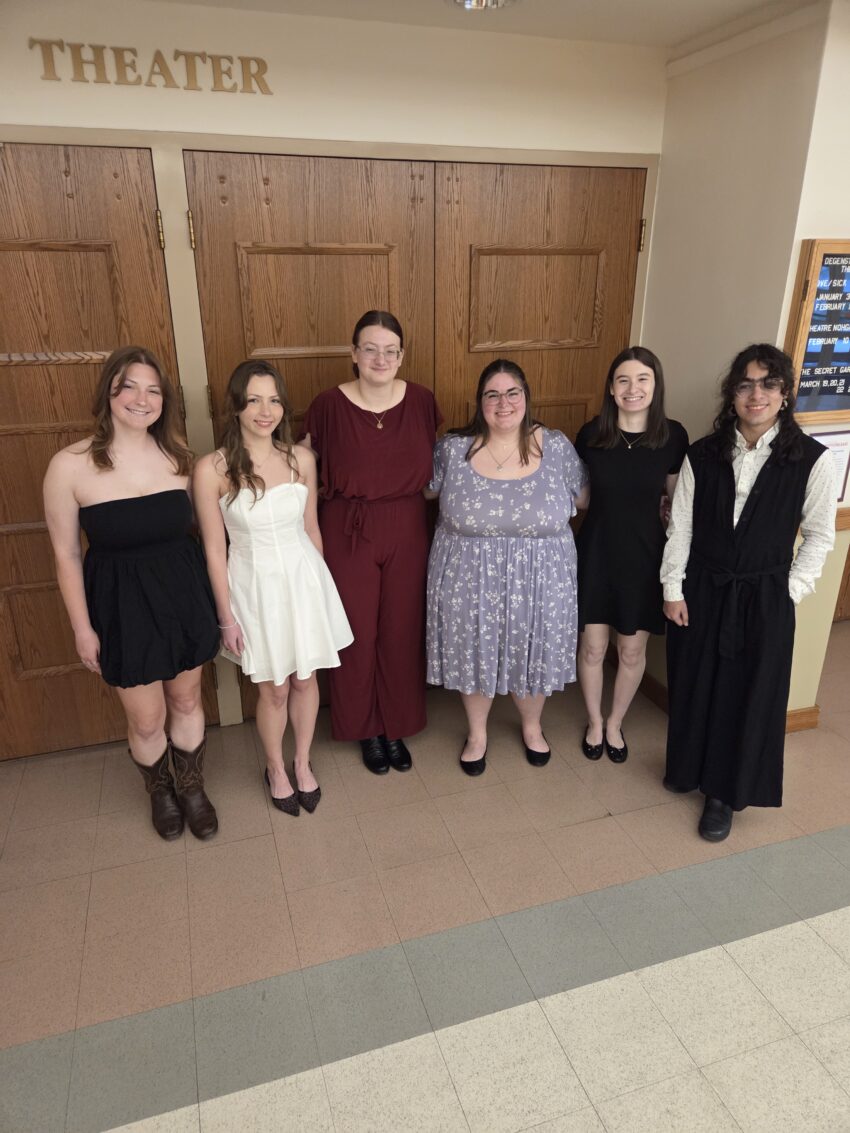
By Jasmine Durst | Photo credits to Monica Prince
The 2025-2026 senior readings came to a finale with six creative writing students reading from various genres such as fiction, essays, and poems.
The first reader, Lindsay Hirschman, read her flash fiction piece, “A Dozen Baby Chicks,” and a poem titled “Beach Day.”
Her fiction piece was about a woman who went on a date with a man to feed peas to ducks, and the man refused to continue seeing her because she “didn’t throw the peas right.” She ordered a dozen baby chicks, thinking they were actual chickens to practice feeding, but she instead got a dozen hookers. At the end, she took them to the bridge to feed the ducks, and she told them to “throw the peas however you like.”
Hirschman’s poem was in the context of an imaginary poet. Her imaginary poet was ChatGPT, which had become a virus on Elon Musk’s computer and called him “Dad.” Hirschman wrote through ChatGPT’s perspective, “I have all the answers in the universe but will never know the meaning of life.”
Next, Mariia Lytvynchuk read an excerpt from her non-fiction short story called “Wake Up,” which was published in a collection of stories named Stories from Ukraine: True Price of War.
She explained that she wrote her short story a couple of months after Russia’s full-scale invasion of Ukraine on February 24, 2022.
Lytvynchuk said: “Through my story, I wanted to show a more intimate and personal perspective of those first days of the war, when fear and uncertainty were extremely high in Kyiv. I focused on how each person reacts differently to such unexpected and traumatic events, emphasizing inner emotions rather than historical details.”
She expressed being thrilled when she learned that her story would be published in Stories from Ukraine: The True Price of War. “At the time, I was only a freshman at university, and my English was still quite weak, so it meant a lot to me to be included in a collection that allows people around the world to read these personal stories.”
According to Lytvynchuk, a copy of this book will soon be available at the Writing Institution.
Logan Davila-Sanabria read her essayette “Painter of Modern Life” and two untitled poems from her chapbook, On Other Deaths.
Logan wrote about how she was sitting near two people on the bus after forgetting her headphones. The two talked about their college days, their friends, and their insecurities after bringing up when they slept together in college and never talked about it again. Logan had originally described the man as the “CEO of man’s lane.”
The fourth reader, Hannah Saylor, read five poems: three from her Intermediate Poetry chapbook, and two from her Intro to Poetry portfolio. Some of the titles included “Unapologetically Authentic” and “Crashing Down.”
In “Unapologetically Authentic,” Saylor wrote, “Perfection is overrated…You belong just as much as everyone else.” In “Crashing Down,” she wrote, “It’s everything but nothing all at once.”
Cyanea Sloan read an excerpt of her short story, “Overboard,” and a flash fiction piece titled “Believer.”
“Overboard” told a story about men’s superstitions while sailing the oceans. Men would throw women overboard as sacrifices to stop storms from destroying their ship. The women went through transformations and turned into sirens.
In “Believer,” Sloan said, “I am not the godly man I once was.”
Finally, Kendall Montney closed the night with her short story “The Princess and the Witch” and flash fiction piece “The One Product to Fix Your Life!”
In her short story, there was the iconic scene of a princess locked in a tower guarded by a dragon. Instead of a man or a knight coming to save her, a witch slayed the dragon. The witch claimed to check every tower that had a dragon because she didn’t know which ones were in use or vacant for use.
The princess had said, “It’s one thing to kill a dragon. It’s another to be this nonchalant about it.” The reward for saving the princess was an agreed marriage, and the witch, who only killed the dragon for its scales for a potion, said, “A wife is a plus.”
In her flash fiction piece, Montney said, “Imaginary friends are the backbone of life.” It acted as a sales pitch for “buying” an imaginary friend while also being a sort of commentary on capitalism. One of the examples was that if you were in jail, you could go to the beach with your imaginary friend. Though, of course, the disclaimer was that this was all in one’s mind and not literally.
On Wed. April 15, the English & Creative Writing Department is hosting Making Public, its annual celebration of all the literary publications on campus, in Stretansky at 7:00 p.m. Hope to see you there!