

By James Shephard; Photo Credits to James Shephard
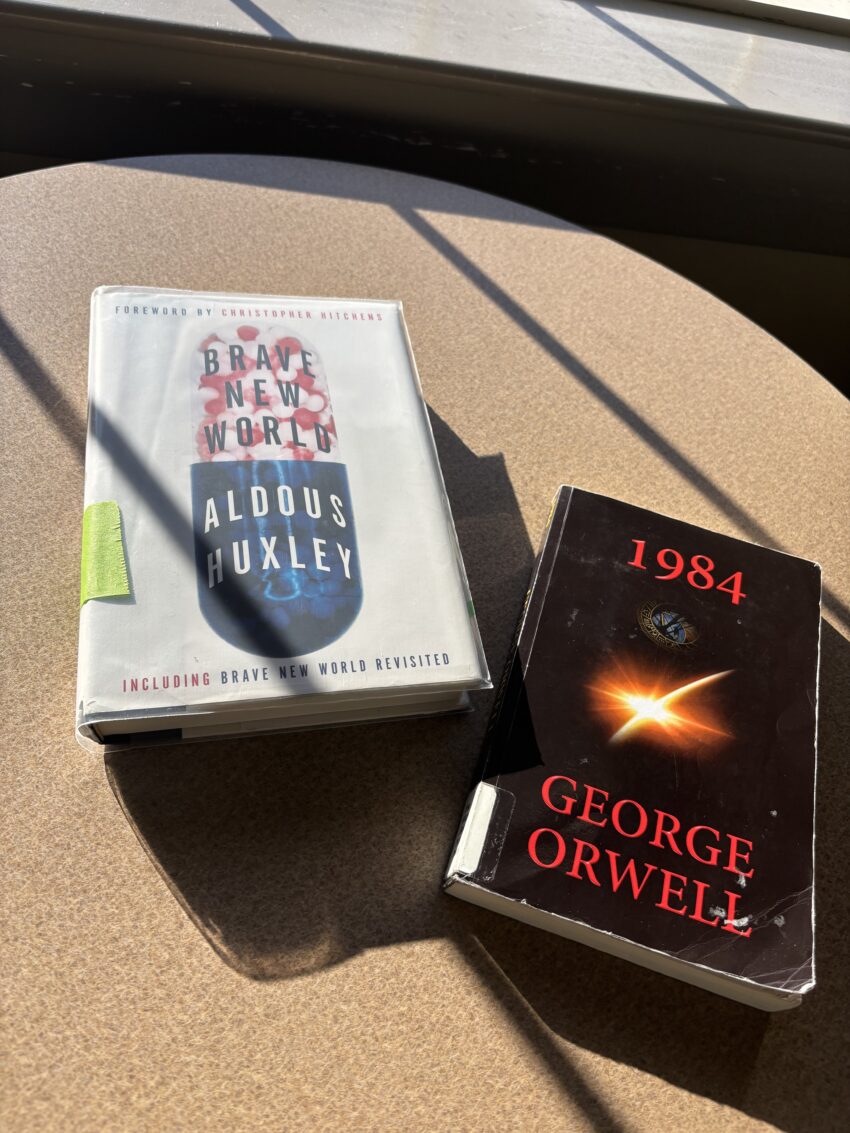
In 1932, Aldous Huxley imagined a society so satiated, entertained, and comfortable that it no longer cared about its freedom. Over a decade later in 1949, George Orwell depicted a future terrified of its government and unchecked power. Both perceived humanity as enthralled in a world where the individual could not overcome the society they found themselves in.
The question asked by many literary scholars and readers alike nearly a century later is this: which author predicted our future more accurately?
“1984” follows a man by the name of Winston Smith who lives under the totalitarian superstate of Oceania, encompassing the Americas, the British Isles, Australasia, and parts of southern Africa, all of which are ruled by the Party under Big Brother.
In this superstate, The Party, figure headed by Big Brother, maintains absolute control through constant surveillance, control over language, the Thought Police, and manipulation of information, history, and truth. Citizens are subjected to indoctrination, torture, and forced loyalty, ensuring obedience and even love for Big Brother and the totalitarian regime.
This governmental rule stands as a representation of absolute control, manipulation of truth and information, and the suppression and loss of individual freedoms, as Orwell’s fears were not just that a government was capable of this complete power, but that it could condition the population to remain obedient and incapable of recognizing its faults.
This kind of fear and concern feels familiar in a time where misinformation, inauthenticity through artificial intelligence, and constant access to surveillance have left their mark on modern society. However, we are not yet Oceania, are we?
We have access to an abundance of knowledge and fact checking tools, books and independent journalism, control over our government, the ability to think critically about our world and our society, and the ability to exercise our freedoms.
In Huxley’s “Brave New World,” however, we are introduced to a world conditioned to constant happiness and desire for the world around them. With natural conception eliminated in favor of genetic engineering, an abundance of sex, drugs, and entertainment, the instant gratification and undesirable nature of discomfort or any other emotion than happiness, Huxley offers a world not stripped of its freedoms, but one that willingly relinquishes them.
We are introduced to characters like Bernard Marx, Lenina, Helmholtz, and Mustapha Mond who live within this world of constant contentment, and we witness the way society passively conforms to a doctrine of “Community, Identity, Stability” and a loss of individuality, family, and emotion.
Juxtaposing this world is the character of John the Savage, a man who grew up in a separated colony of the world in the Americas. He learned through Shakespeare, and has a passion for life, choice, emotion, and individuality. It is through this conflict of ideals that we see the cost of this artificial existence.
Looking to our own society, we can easily identify how on the nose Huxley’s world compares to our own. The need for instant gratification, constant distraction and the blinding of senses, and the conditioning of silence and contentment are frighteningly relevant in our lives. Huxley’s government does not force its society to stop thinking; it gives it so much to process that they can’t help but become blind. Sound familiar?
Yet there remains a part of our world unlike Huxley’s vision for the future. We have not yet lost sight of our own emotions and agency. We can still choose the path forward, rather than have that path chosen for us. Our world does not lack love and family, or art and creation. Hope remains in our society unlike that of Huxley’s.
So, perhaps the mistake is asking whether it was Orwell or Huxley that correctly predicted our future, and rather the more uncomfortable possibility is that both authors were writing two halves of the same future. One half controls the information we receive, and the other controls the emotions and desire surrounding that information.
Orwell envisioned a society that controls what people know, and had his citizens asking, “what am I allowed to think?” Huxley foresaw a world controlling what people want to know, having citizens ask, “why should I think about this at all?” Technological advances can now facilitate both. We have developed technologies capable of watching us, systems capable of influencing what we see, and entertainment capable of occupying nearly every empty moment of our lives.
Algorithms rule over our digital lives, curating what we see and why we see it, all while learning what will keep us watching and what will keep us content. The result is neither an authoritarian dystopia nor a pleasure-filled utopia, but rather a more complicated world of our own making. Yet, none of these things automatically make us prisoners; the question is what we choose to do with them. us prisoners. The question is what we choose to do with them.
Orwell warned us of a world where people would be afraid to think. Huxley warned us of a world where people would forget how to think. Perhaps the future does not belong entirely to Orwell or Huxley. Perhaps it belongs to us, and the first step toward avoiding either world is recognizing the moment when we stop asking questions and start allowing others to control us.