







By Jaidyn Steinbrecher
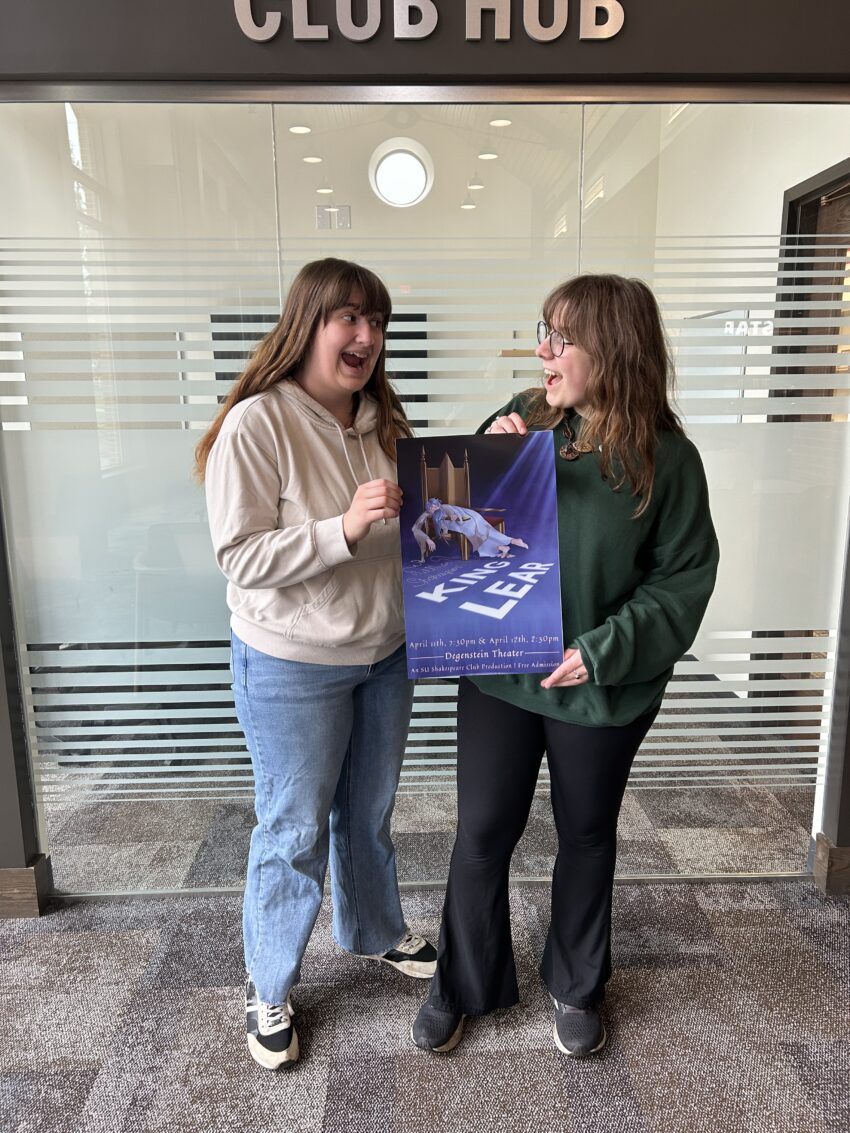
After three years of leading Susquehanna University’s Shakespeare Club, seniors Ella Baker and Gracie White are closing out their tenure with their most ambitious production yet: King Lear.
The classic tragedy, which the directors call both exhilarating and devastating, will be staged April 11 at 7:30 p.m. and April 12 at 2:30 p.m. in Degenstein Theater. The performances are free and open to the public.
King Lear follows an aging king who divides his kingdom among his daughters based on public professions of love, only to be betrayed and stripped of power, dignity and sanity. As political authority collapses, the play traces parallel stories of familial cruelty, betrayal, and ultimately, devastating loss. By the end, nearly every major character is destroyed, leaving audiences to grapple with questions of power, justice and kindness.
For Baker and White, choosing King Lear was both intentional and deeply personal. The pair knew they wanted to end their time at Susquehanna with a tragedy and nearly settled on Romeo and Juliet before returning to Lear.
“It’s intense—I mean, we have an eye-gouging scene,” Baker said. “It’s a lot to deal with as directors, but we felt ready for it.”
Baker said she had a connection to the play even before joining the Shakespeare Club, calling it the first Shakespeare work that made her understand why the playwright endures.
“It was the first time I gave Shakespeare a chance,” she said. “I was like, ‘Oh, this is why people love this guy.’”
White said her connection came later, after seeing a live production while traveling abroad.
“I saw King Lear in Australia in this weird art space, and I cried,” she said. “It was awesome.”
Both directors said that living with the play over the course of the semester, quoting it daily and dissecting its characters, made it the right final choice.
The directors’ journey with Shakespeare began in their freshman year, when they auditioned together for Two Gentlemen of Verona. With few club members and no executive board, Baker and White were unexpectedly asked to step into leadership roles early.
“We had never been to a Shakespeare Club meeting before auditions,” Baker said. “We just went, had a really great time and then suddenly we were in charge.”
Since then, the pair has directed A Midsummer Night’s Dream, which White called their “baby play,” and Measure for Measure, a darker “problem play” they chose to set in the 1920s. Each production taught them something new, from blocking scenes to cutting scripts and building a unified vision.
“Every year we’ve gotten better at collaborating,” Baker said. “This year, we blocked the entire show together. It’s the strongest process we’ve ever had.”
Those skills proved essential for King Lear, which originally runs nearly four hours. Baker and White cut the script down to just under two hours without rearranging scenes or modernizing the language.
“No rearrangement. No word replacement. Just cutting,” Baker said. “If it can’t be understood without a Google search, we cut it.”
White, who describes herself as “very anti-rearrangement,” said the goal was to preserve Shakespeare’s intent while respecting the audience’s intelligence.
“People underestimate their ability to understand Shakespeare,” she said. “There’s an intellectual respect for the audience in keeping the language.”
The production includes a single intermission, placed about two-thirds of the way through the play, immediately following one of its most infamous moments: the blinding of Gloucester.
The scene will feature fake blood, sound design, and carefully staged violence. Actor Bronwyn Lucyszyn, who plays Gloucester, said the moment is meant to shock.
“It kind of comes out of nowhere, which is great,” Lucyszyn said.
“It’s going to be bloody,” said Baker.
“It’s going to be screamy,” added White.
“It’s going to be a delight,” Lucyszyn finished.
The production’s minimalist staging heightens moments like this. Baker described the set as “almost bare,” with minimal props, slight storm effects, limited lighting and music composed by senior Brandon Snare, all throughout.
“One of the themes of Lear is nothingness—having everything stripped away from you,” White said. “So, we wanted the stage to reflect that.”
Casting remains one of the directors’ favorite parts of the process. Nearly 20 students make up the cast, with ensemble members playing multiple roles. Everyone who auditioned was cast.
“Some of our biggest strengths are our instincts,” Baker said. “Last-minute decisions that somehow end up being perfect.”
White agreed, calling auditions “the hardest day of our lives every year.”
Several actors have shaped their roles in unexpected ways, including the Fool, played by Jackson Schneider, and Edgar, played by Francis Rogai, whose scenes balance comedy, madness and heartbreak.
Baker said watching the cast grow into their characters has been one of the most rewarding parts of the process.
When it comes to King Lear himself, the directors view the character as deeply flawed.
“He leans more villain than victim,” Baker said. “Maybe 60% evil.”
“40% just okay,” added White.
As opening night approaches, both directors say they are most excited for the storm scenes and the ending, which leaves multiple bodies onstage and no easy resolution.
“I hope people walk away with something,” White said. “Pick any theme and think about it.”
Above all, Baker and White hope the production invites audiences to engage with Shakespeare in a new way.
“Our goal is to make people realize Shakespeare is not the devil,” White said. “His work is worth engaging with.”
April 11 at 7:30 p.m. and April 12 at 2:30 p.m. in Degenstein Theater is your last chance to see the wonderful works of Ella Baker and Gracie White at Susquehanna.