



By Haley Zeller, Arts & Entertainment Editor
How can we use stories, rather than revenge, to resolve deep-rooted conflicts?
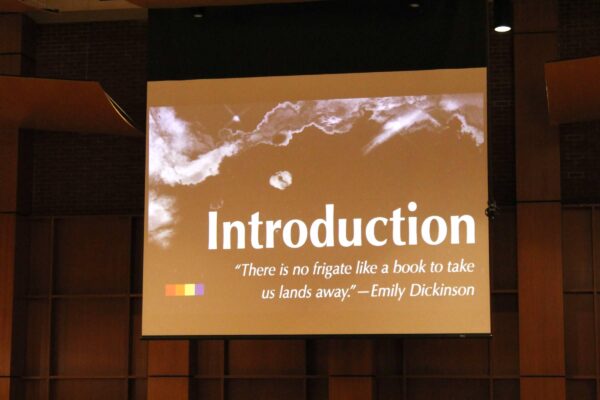
On Wed. March 25, Dr. Glen Retief and Rabbi Nina Mandel hosted a presentation on the documentary “One Day After Peace” and examined if truth and reconciliation is possible following the Israeli-Palestinian conflict.
Rabbi Mandel explained that in 1995, the African government established the Truth and Reconciliation Commission (TRC) to facilitate peaceful reconciliation following the violence and segregation of apartheid.
She talked about her extensive work with peace groups in the Israeli-Palestinian conflict and the importance of community over division. Conflict, when resolved by winners and losers, sows resentment instead of closure.
Rabbi Mandel and Dr. Retief showed five clips from Miri and Erez Laufer’s documentary and aimed to answer these questions: Is forgiveness possible; is healing possible; and is the TRC’s method applicable to other conflicts?
“One Day After Peace” follows Robi Damelin, an Israeli mother who lost her son to a Palestinian sniper, and her journey to unite bereaved parents of both sides to achieve closure and forgiveness. The film shows moments from South African TRC hearings, in which amnesty was granted to anyone willing to admit the truth of their crimes regardless of political motivation. By releasing these prisoners, the reconciliation process was able to move forward.
Following the clips, Retief discussed his life in South Africa under apartheid, the legal system of segregation, which began in 1948 and wasn’t deconstructed until the ‘90s.
“Under apartheid, we lived in an atmosphere of war. In the 1980s, I was required to attend a whites-only government boarding high school. We had to travel through designated black areas to get there. In this time of uprising, there was rock throwing, burned buses, and people killing civilians and military. Our school buses had to be escorted by armored cars.”
After apartheid, Retief’s school was the first to open its school to blacks. In response, a white supremacist blew up the athletic stadium. Retief and his family heard the explosion from their home; an unfortunately regular sound in the morning.
Post-apartheid South Africa was marked by turbulence. However, the TRC hoped to reconcile survivors and victims.
“The TRC was the first to aim at restorative justice,” Retief said. “There were two years of public hearings. When I visited home, I would be glued to the TV. The testimonies were powerful.” During these testimonies, over 22,000 human rights violations were detailed; they are all on public record.
Despite its influence, the TRC was criticized by many young South Africans. Some believed the commission provided political usefulness, rather than being about anything “benign.”
Additionally, the TRC rejects South Africa’s deep-rooted traditions of self-justice. Retief said, “I take students on study abroad trips to coastal towns of South Africa where there are no police, no hospitals, for miles around. If a crime is committed, the village gathers to right the situation. The survivors lead the discussion and explain what they need to achieve closure and justice.”
In TRC hearings, survivors had no say in the perpetrators’ justice. The more actions the perpetrators disclosed, the more likely they were to receive amnesty. Retief described it as “paradoxical.”
Finally, the commission only investigated gross human rights violations including torture, murder, and sexual assault. Many injustices, like the uprooting of citizens from their homes, were not addressed, and survivors received tokenistic reparations—nothing substantial.
However, advocates like Desmond Tutu, Chairperson of the TRC and the 1984 Nobel Peace Prize recipient, recognized the importance of forgiveness and restorative justice. Forgiving doesn’t mean forgetting, but it’s vital that victims can share their stories.
By listening to and validating one another, victims break the endless cycle of revenge and violence. It’s easiest to desire revenge, but it’s harder to forgive. Individuals and their stories prove that they have the power to bridge conflict.
Retief said, “The TRC was so successful as a truth commission. The five volumes of testimonies make it hard to deny the narrative that speaks the truth: apartheid was a crime against humanity. It’s a big change in the framing, and I think that contributes to peace because the fundamentals can’t be argued.”
“In the Israeli-Palestinian realm, it’s essential to consider narratives. But, this is made difficult because one of the narratives is the Bible. Formative world views are difficult to ask people to let go of,” Rabbi Mandel says.
“However, part of remembering these narratives is sharing them and finding a way to coexist. We don’t have to approve of the other narrative, but we have to validate them. There’s so much value in hearing stories and being made uncomfortable. Until we’re able to say we don’t agree with each other, but we know what’s real to one another, we can’t achieve reconciliation.”
In reference to political division in the U.S. and ongoing global conflicts, Dr. Drew Hubbel said, “The elites and leaders often perpetuate cycles of violence. I like the idea of a grass-roots approach, and maybe that’s where reconciliation needs to be led from. We should be able to look to our elites to provide reasoning; the question is how to discourage them from using violence as a solution.”
Mandel responded, “I’m never going to get access to the political leaders out there, but I have access to you and who you know. I’m talking about a methodology, not an ideology, of listening. No matter what you say, I won’t get up, and I will understand your truth.”
These powerful statements ended the evening and left students with a message of hope. If we can find commonalities with those we disagree with, our conflicts may finally see peace, compromise, and reconciliation.