






By Lucy Honeywell and Jaidyn Steinbrecher; Photo Credits to Hannah Matriccino and Jaidyn Steinbrecher
“Democracy is a participation sport,” former Vice President Mike Pence said, a message that framed his visit to Susquehanna University this past Monday.
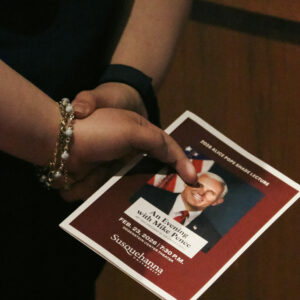
Pence spoke at Susquehanna University on Feb. 23 at 7:30 p.m. in the Degenstein Center Theater as part of the annual Alice Pope Shade Lecture, a nationally recognized series hosted by the Department of Religious Studies examining the role of religion in public life.
The announcement has drawn mixed reactions across campus. An Institutional Review Board-approved student survey of 257 respondents found that 65% opposed Pence’s invitation, 17% were indifferent and 18% supported it, with 58% saying they did not plan to attend.
For more information, read the preview article, “Mike Pence to speak as the university’s annual Alice Pope Shade Lecture.”
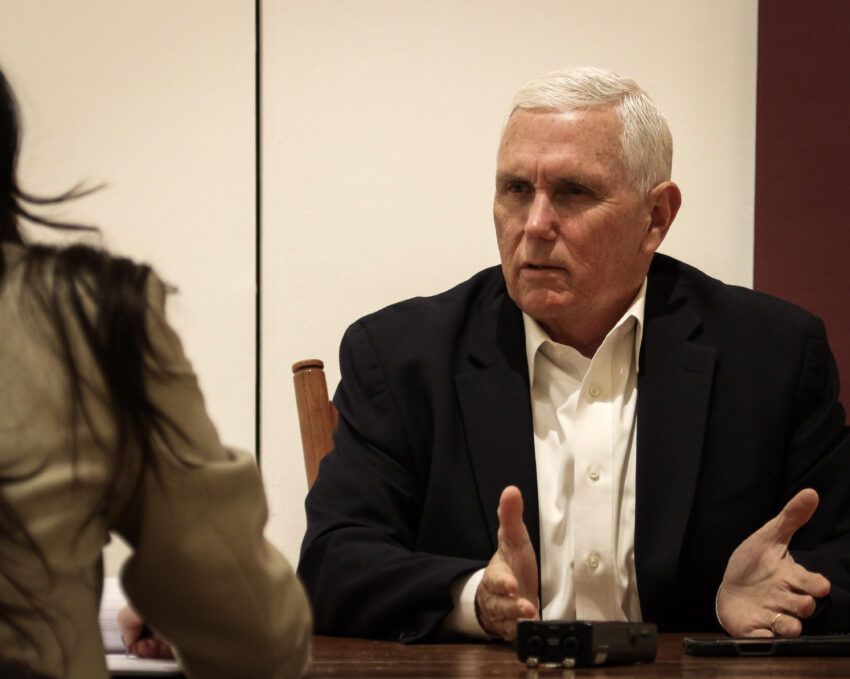
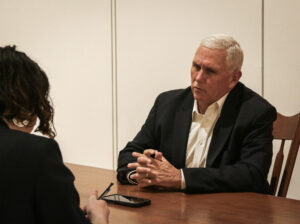
Yet still, the theater filled up with audience members willing to listen to the former vice president. Additionally, Political Science and Religious Studies students, as well as two members from each of Susquehanna’s main news providers—The Quill and WQSU—were given the opportunity to meet with Pence for an extended interview prior to the lecture.
An Interview with Mike Pence
By Jaidyn Steinbrecher
Mike Pence said his Christian faith has shaped every chapter of his life, from a teenage rejection of religion to a public break with his own party’s president, during an extended interview ahead of his appearance at the Alice Pope Shade Lecture.
Speaking about his spiritual journey, political evolution, and the events of Jan. 6, 2021, Pence described faith as both a personal anchor and a public compass.
Pence was first asked when his faith became central to his life. He said it wasn’t until the end of his freshman year in college.
Raised in what he described as a “wonderful Catholic family,” Pence attended eight years of Catholic school. But by high school, he said, he had drifted away from religion.
“I just decided that religion was a crutch. I didn’t need it,” he said, adding that he did not walk away specifically from Catholicism but from faith altogether.
By the time he left for college, Pence said he sensed “something was missing.” He began meeting students who talked about having a personal relationship with God, without emphasizing denomination.
“They just said they were Christians,” Pence said.
He started attending a campus fellowship group and reading the Bible seriously for the first time. In the spring of 1978, at a contemporary Christian music festival in Wilmore, Kentucky, he heard a sermon that struck him in a new way.
“It was like I heard the words for the first time,” Pence said, referencing John 3:16.
After an invitation from a pastor to come forward and pray, Pence said he walked down a hill at the festival and prayed with a volunteer pastor, accepting Jesus Christ as his Lord and Savior.
“I think it changed my life forever,” he said.
Still, Pence acknowledged that the transformation was gradual. “I think my eternity was secured in that moment,” he said, “but it would take a while before it changed me.”
He said it was not until around age 30 that he began consistently applying his faith to his long-standing ambition to serve in public office.
Pence said he learned early, sometimes painfully, how difficult it can be to reconcile Christian teachings with the realities of political campaigns.
He acknowledged participating in “pretty rough, negative campaigns” early in his career. Over time, he said, he came to believe that if he sought office again, he would do so in a way that “honors God first, informs the debate and then worries about winning and losing.”
“As a Christian, I’m required to treat others the way I want to be treated,” Pence said. “Politics too often is more about, ‘Do unto others before they do unto you.’”
When asked how he would explain his connection with God to someone who identifies as agnostic, Pence said he once considered himself an atheist.
“I just figured some people needed religion. I just didn’t,” he said.
What changed, he said, was encountering peers who displayed what he later recognized as joy and steadiness.
“They had a certain ballast in their life that I knew I didn’t have,” Pence said. That observation led him to make his own decision about what he believed.
Pence identified several moments when his faith was tested.
During his first congressional campaign in 1988, he received a call instructing him to rush to the hospital. His father had been admitted. Pence said the sudden death of his father was a defining test of his young faith.
“My dad and I were very close,” he said. “He’s still the best man I ever knew.”
Working through grief while holding onto faith proved challenging, he said.
He also discussed five years of unexplained infertility that he and his wife, Karen, experienced early in their marriage. The couple had no clear medical explanation, he said, calling it a “heartbreaking time.”
The experience later informed his advocacy for fertility treatments and reproductive options for families struggling to conceive.
Pence described Jan. 6, 2021, as a moment when his faith and constitutional oath converged.
As vice president under then-President Donald Trump, Pence presided over the joint session of Congress to certify the Electoral College vote in the 2020 election. Some Trump allies argued Pence could reject or return electoral votes to states.
“I had no such authority,” Pence said. “The Constitution afforded the vice president no such authority, nor should it ever.”
He said the oath he took to support and defend the Constitution ended with the phrase, “So help me God,” which he views as both a public promise and a personal one.
“That was not only a promise that I made to you and to your families,” Pence said, “but it was also a promise that I made in my heart to God.”
Citing Psalm 15, “He keeps his oath even when it hurts,”Pence said he believes he fulfilled his duty by overseeing the peaceful transfer of power.
“It was by His grace that we did our duty that day,” he said.
When asked about increased political involvement among college students, including participation in groups such as Turning Point USA and Young Democratic Socialists of America, Pence welcomed activism across the political spectrum.
“Democracy is a participation sport,” he said.
He urged students to combat apathy and simply “show up,” whether at a local party meeting, club or campaign office.
Pence recounted that at age 15, he already aspired to public office. His father introduced him to a local Democratic Party leader, and Pence became a youth coordinator in Columbus, Indiana, campaigning for President Jimmy Carter in 1978.
As he matured, Pence said his views shifted toward the Republican Party, influenced by his father’s background as a combat veteran and small-business owner and by his belief in free enterprise.
“The first rule of getting involved in politics is just show up,” he said. “I promise you they’ll put you to work.”
Reflecting on his college-aged self, Pence said he would offer two main pieces of advice: believe big dreams are possible and cultivate character early.
“Don’t doubt that it can happen,” he said, noting his own path from the grandson of Irish immigrants and the son of a gas station owner in southern Indiana to serving in Congress, as governor and as vice president.
He also stressed preparation of character before moments of crisis.
“I hold the view that adversity doesn’t create character. Adversity reveals character,” Pence said. “When your time of testing comes, you’re going to be the person you were preparing to be in every quiet moment before that.”
He encouraged students to develop humility, integrity and a strong understanding of the nation’s founding principles, warning that their futures will arrive “faster than you could possibly imagine.”
When asked how he would respond if a major biblical event were proven to be metaphorical rather than literal, Pence said he considers himself a “Bible-believing Christian” who accepts Scripture “front to back.”
“I’d probably just take it up with the Lord,” he said.
Throughout the interview, Pence returned repeatedly to the idea that faith is not separate from his public life but foundational to it, guiding his decisions in campaigns, in personal trials and, he said, in one of the most consequential days in modern American political history.
An Evening with Mike Pence
By Lucy Honeywell and Jaidyn Steinbrecher
Mike Pence returned to familiar themes of faith, constitutional duty and traditional conservatism during the 2026 Alice Pope Shade Lecture at Susquehanna University, telling students that “adversity doesn’t create character, adversity reveals character.”
The event, held in Degenstein Theater, featured a moderated conversation with Religious Studies Department Head Jeff Mann followed by an extended student question-and-answer session focused on religion, political division and Pence’s record in office.
Mann introduced Pence as a “proud Hoosier,” tracing his path from Columbus, Indiana, to the vice presidency. Pence, born in 1959, graduated from Hanover College and Indiana University’s law school before serving in the U.S. House of Representatives and as Indiana’s governor.
He later became the nation’s 48th vice president.
Mann also recognized Rebecca Shade Mignot ’54. Mignot graduated from Susquehanna with a degree in music. Mignot established the Alice Pope Shade Fund in 1983 to commemorate her mother, Alice. The fund supports the Alice Pope Shade lecture series hosted on campus each year.
Pence thanked university leadership and Mignot for sustaining what he described as a nationally recognized forum for public debate.
Asked how he discerns whether guidance comes from God rather than personal desire, Pence reflected on his conversion experience as a college freshman at a small liberal arts school in Indiana and a Christian music festival at Asbury University in 1978.
He described himself as “a Christian, a conservative and a Republican—in that order,” saying his faith has shaped how he tries to conduct himself in public life.
“Politics too often is, ‘Do unto others before they do unto you,’” Pence said. He acknowledged participating in negative campaigning early in his career but said he later committed to running campaigns that would “honor God first.”
Mann asked Pence about concerns surrounding Christian nationalism and divisions within the Republican Party.
Pence said he encounters the term mostly in media discussions and online but views current tensions within the GOP as rooted more in debates over policy direction—particularly populism, isolationism and the size of government.
He contrasted what he called “traditional conservative” principles, associated with former President Ronald Reagan, with a rising populist strain that questions free trade, foreign engagement and long-standing fiscal priorities.
Pence voiced strong support for continued U.S. aid to Ukraine in its war with Russia, arguing that failure to deter Russian President Vladimir Putin would threaten broader European security.
He also criticized expansive tariff policies imposed unilaterally by former President Donald Trump, contending that the Constitution assigns taxation authority to Congress. Pence said he supported legal challenges to what he called Trump’s “Liberation Day” tariffs and praised the Supreme Court for upholding separation of powers.
When asked about his long-standing opposition to same-sex marriage, Pence reiterated his belief that marriage is between one man and one woman but acknowledged the Supreme Court’s ruling recognizing same-sex marriage nationwide.
“We can disagree with the Supreme Court, but we can’t disobey it,” he said.
Pence framed the issue primarily as one of religious liberty, emphasizing the First Amendment’s protection of the free exercise of religion. He said courts must ensure that those who hold traditional religious views are not compelled to act against their conscience.
Referencing Pence’s own writings criticizing negative campaigning, Mann asked why Pence agreed to join Trump’s 2016 ticket.
Pence said his decision centered on whether he believed he could help advance policies he supported, including tax cuts, military investment and conservative judicial appointments.
“Our administration didn’t end the way I wanted it to,” Pence said, referring to Jan. 6, 2021; but he expressed pride in what he described as policy accomplishments during the first four years.
He added that while he and Trump have stylistic differences, he respected the voters’ choice and sought to support the administration’s agenda.
When asked how individuals cultivate the strength to do what is right under pressure, Pence rejected the idea that hardship builds character.
“Adversity reveals character,” he said. “When your time of testing comes, you’re going to be the person you were preparing to be in every quiet moment before that.”
He cited lessons learned after two failed congressional campaigns in the late 1980s and early 1990s, describing that period as a political “wilderness” that reshaped his approach.
Mann referenced Pence’s father, a Korean War veteran in the 45th Infantry Division, and asked how his example influenced Pence’s understanding of duty.
Pence said his father instilled discipline and a sense of obligation, often reminding his sons that “to whom much is given, much will be required.”
He connected that principle to his own oath of office, which concludes with the phrase “so help me God.”
“The genius of the American experiment,” Pence said, “is in the character of the American people.”
Students posed questions on topics ranging from immigration enforcement to campus polarization.
On immigration, Pence defended the role of law enforcement and U.S. Immigration and Customs Enforcement officers while emphasizing the need for accountability in cases involving police shootings. He called for transparent investigations in such incidents but maintained that Americans “have every right to have safe streets.”
Responding to a question about navigating polarization on campus, Pence encouraged students to practice civility and respectful debate.
“Always be prepared to give a reason for the hope that you have,” he said, “but do so with gentleness and respect.”
He argued that despite political divisions amplified by media and social platforms, Americans generally cooperate and support one another in times of crisis.
“When the wind blows and beats against the house … the only thing you can’t find the next day is a parking space,” Pence said, describing community responses to natural disasters. “People come from everywhere to help.”
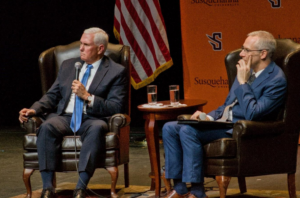
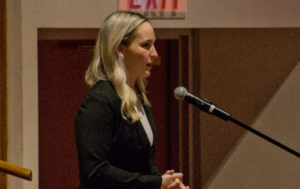
One student referenced Matthew 25,”love your neighbor as yourself,” while questioning Pence about his 2015 signing of Indiana’s Religious Freedom Restoration Act and his past support for a proposed constitutional amendment banning same-sex marriage in the state. The student asked how Pence reconciles those actions with the biblical command to love LGBTQ neighbors and whether he would do anything differently.
Pence responded that Indiana’s law mirrored federal and other state Religious Freedom Restoration Acts, including one signed by former President Bill Clinton, and said it was never intended to permit discrimination.
He noted that the bill was later amended to clarify that it could not be used as a “license to discriminate.” While acknowledging the controversy as a “learning experience,” Pence maintained that, in a free society, protections must exist both for LGBTQ Americans and for those who hold traditional religious views on marriage. He added that he never wants anyone to feel unloved by him or his family.
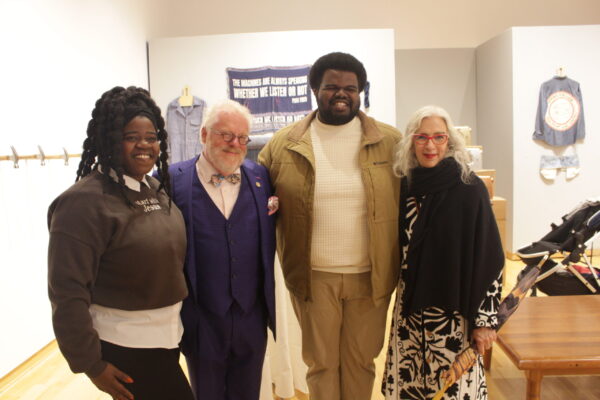
Interviews after the lecture with Student Government Association (SGA) leaders offered varied perspectives on the lecture’s impact.
Kyra Keenan, SGA president, said she attended not because she agrees with Pence’s politics but to hear a perspective different from her own.
“I felt it was an extraordinary opportunity to learn about beliefs different from my own,” Keenan said. “It’s clear former Vice President Pence has lived through very unique experiences serving our government with President Trump.”
Keenan described some of Pence’s answers as “quite interesting” but said others were “as expected, disappointing.”
“Mr. Pence has definitely begun to separate his own views from that of the Trump administration, but he still holds some hateful beliefs that I cannot get behind,” she said.
Despite those disagreements, Keenan said she was grateful to attend.
“In the end, I left with a very neutral impact,” she said. “It’s almost as if the positive, surprising statements were overtaken by the more disappointing statements.”
Her favorite portion of the event, she said, was Pence’s support for Ukraine.
“It gave me hope that injustices around the world are being recognized,” Keenan said.
Jonathan Ulicny, SGA vice president, described the lecture as an opportunity to reflect on shared civic values.
“The former vice president shared his personal religious thoughts and beliefs Monday evening—thoughts and beliefs that Mr. Pence pointedly said are ennobled to every citizen of the United States in the Declaration of Independence,” Ulicny said.
In a period of political polarization, Ulicny said Pence emphasized that elected officials can appear more divided than the American public.
“He inspired a civil discussion of our values as students and how to hold each other accountable while respecting each person’s character,” Ulicny said.
Ulicny characterized the event as a positive experience.
“As a religious lecture, I felt as though I could relate to Mr. Pence’s discussion of his faith and how it guides his values,” Ulicny said. “Importantly, these values should never be forced onto others.”
He added that compassion, forgiveness and understanding were key themes he drew from the discussion and said the lecture aligned with Susquehanna University’s emphasis on open dialogue.
“All of the student questions for Mr. Pence were engaged,” Ulicny said. “His responses called for understanding between everyone and the respectful discussion of many ideas. This concept of openness is at the core of Susquehanna University’s mission.”
Throughout the evening, Pence returned to optimism grounded in faith and civic identity. He expressed confidence in both divine providence and what he described as the enduring generosity of the American people.
“My confidence about the future of America comes from my faith in God, but also from faith in the American people,” Pence said, “I am convinced the American people are the most idealistic, generous, caring, patriotic people the world has ever known. We just need government as good as our people.”