



By Jasmine Durst
“You don’t need a pedigree to help people,” said Balto in the 1995 animated film Balto.
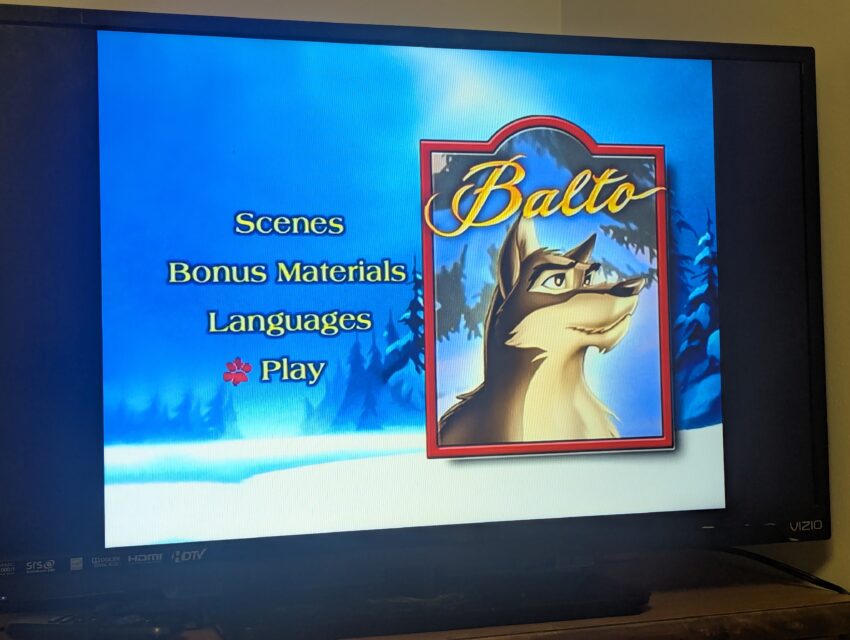
On the back of the Balto 3-movie adventure pack, the cover designer for Universal Pictures Home Entertainment wrote the following synopsis for the Balto movie:
“Inspired by an incredible true story, the original film follows Balto as he braves an Arctic storm to retrieve life-saving medicine for Alaska’s children.”
The movie takes place in Nome, Alaska, in the winter of 1925 and switches between the animated story of Balto and live-action scenes of grown-up Rosy and her unnamed granddaughter in New York City.
In the movie, Balto is a half-dog, half-wolf who is treated as an outsider by the townsfolk and bullied by the main antagonist, Steele the sled dog, and his sled team. Balto falls in love with a red husky named Jenna, Rosy’s dog, and lives on a broken-down ship with his friends Boris the goose and Muk and Luk the polar bears.
Rosy has a dream of being a musher, and at the beginning of the movie, she, as a little girl, gets her very own child-sized sled that Jenna can pull from her parents, and her mother gives her a musher’s hat. Balto shows Jenna how to make “the northern lights” with broken glass bottles of various colors and a light from the north.
Rosy and other children get sick with diphtheria, a contagious bacterial infection that affects the throat and airways, with Rosy being the 18th case.
The doctor had run out of the antidote, and there is a scene where the casket maker was making child-sized coffins. The medicine failed to be shipped to Nome by plane because of the snowstorm, so they shipped it by rail while Nome picked the fastest dogs for the sled team to reach and bring back the medicine.
According to the Alaska State Archives: “The life-saving serum was delivered to Nome in a record-breaking 127.5 hours, without a single broken vial. Many aspects of this journey are commemorated annually in the Iditarod dog sled race.” The Alaskan Mushing School says that the 1925 serum run took 5 ½ days to retrieve the antitoxin from the train and bring it back to Nome, Alaska.
The two major fight scenes in the movie are Balto versus the black bear and Balto versus Steele.
The fight scenes are not long or drawn out because the movie is a memorial to Balto bringing the medicine home to save the children, rather than an action movie.
Balto saved dozens of people, especially children, at the risk of his own life, even though he was treated badly for being a wolf-dog in the movie.