








Article and photography by Jasmine Durst
Approximately 7.3 trillion metric tons of human-caused carbon have been created, according to a bioethicist and moral philosopher from Johns Hopkins University.
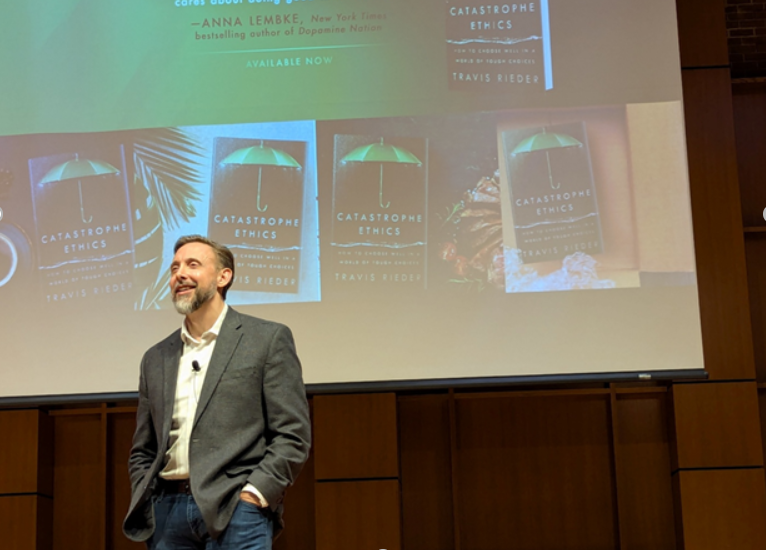
“Responsible Consumption in a World on Fire” was the 2025 annual Edward S. and A. Rita Schmidt Lectureship in Ethics, featuring Travis N. Rieder as the guest speaker. This lecture was made possible through the generous gifts of Edward R. Schmidt (’69), an SU Emeritus Board member with a bachelor’s in sciences in Economics from Susquehanna University.
Travis N. Rieder is a bioethicist and moral philosopher at the Johns Hopkins Berman Institute of Bioethics, splitting his time between teaching at the graduate and undergraduate levels, conducting research, and communicating with the public. In forming the Edward S. and A. Rita Schmidt Lectureship in Ethics, Mr. Schmidt emphasized his desire to leave students an understanding and appreciation for the value and role of ethics in professional and personal endeavors.
Before beginning the lecture, Rieder said, “This has been an incredible visit, and I haven’t even done my job yet.”
As the event kicked off, Rieder said, “Younger people’s words are more effective than older people’s, even if it’s the same message.”
Flying is one of the most carbon-expensive things that humans may ever do, but, according to Rieder, having a child is the most carbon-expensive thing humans will ever do in their lives. He spoke about the carbon legacy and how children will grow up and possibly have their own children, repeating the carbon legacy.
A carbon footprint is a measure of the total amount of greenhouse gases (GHGs) released into the atmosphere because of an individual, organization, product, or places’ activities.
Rieder said that he became a vegan throughout his adult life, including giving up cow milk for animal welfare reasons, and because it has a high carbon footprint. Rieder said, “Eat low on the food chain.” Soy milk did not agree with him, and oat milk, in his opinion, was disgusting. Almond milk was cheaper, tasted good, and had a low carbon footprint, but it had a high water footprint. He said that he solved the problem by drinking whatever was in the house while moderately guilty.
Rieder explains that there will not always be a meaningful outcome to some activities.
“Even if you eat meat, you do not cause harm to animals.” He explained that you may have a bigger impact by buying meat from a local farm, but global farms don’t notice if you don’t eat meat. Global farms will still kill the same number of animals even if a million people stop eating red meat or poultry, but they may lower the prices and possibly ship overseas, leaving more carbon footprints.
Instead of a gas car, Rieder said electric cars use less fossil fuels and do not leave as many carbon footprints. The issue is that electric cars require electricity to be charged, racking up the electric bill along with indoor electricity such as lights, AC, and heaters.
Rieder said that he considered adding solar panels to his house, and he got a quote for $65,000 to take the energy bill to $0, which Rieder mentioned no average person could afford without years of saving.
The purity ethic, according to Rieder, is not to have kids, to be vegan, to not fly, to install $65,000 solar panels, etc.
Cobalt is in every phone, laptop, and electric car. There are cobalt mines in the Democratic Republic of Congo where much of the world’s cobalt is mined using modern-day-like slavery, child labor, and slave wages. Rieder said that the more people who buy electronics, the more it enables slave labor.
People want others to join their cause and get out there to make noise. They want politicians to do something because influential figures and corporations have more power than the average individual. The only problem, according to Rieder, is that “reasons come very cheap.” If there is value in it, then people have a reason to do it. If there is a disvalue in it, people have a reason not to do it. Rieder said, “We need to triage. We can’t do everything we have a moral reason to do. It’s part of being human.” Rieder explained that it is unclear on what grounds we could say there is a right way to organize one’s response to these reasons.
The Annual Schmidt Lecture held on Oct. 27 was a success. The Stretansky Hall auditorium was almost full, with students, professors, President Jonathan Green, and First Lady Lynn Buck in attendance. We hope everyone who attended enjoyed this insightful lecture!