



By Lily Papendick
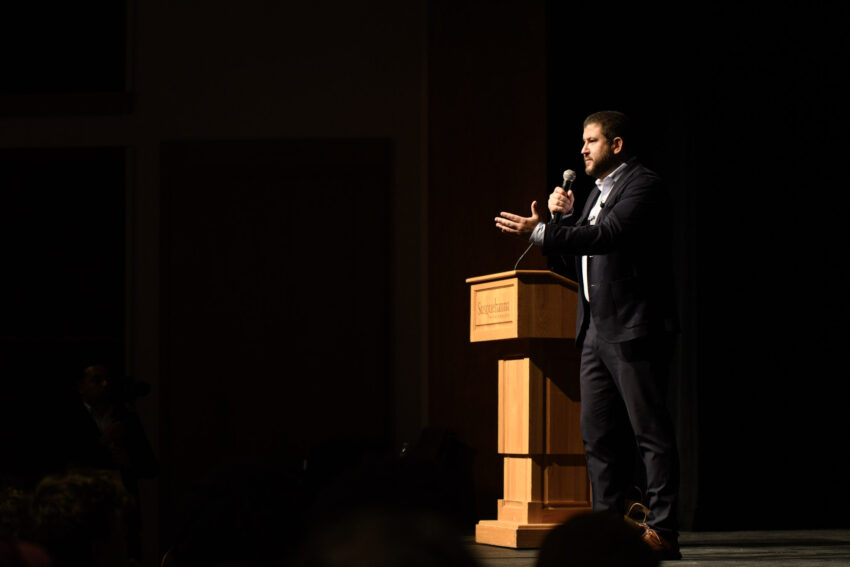
On Thursday, Sept. 11, Venezuelan political leader David Smolansky delivered this year’s Weis Memorial Lecture at 7 p.m. in the Degenstein Theater.
Following an introduction by Dr. Matthew Rousu, the dean of the Sigmund Weis School of Business, Smolansky took to the stage. In remembrance of 9/11, he took care to honor those who passed away and recounted his own experience in New York City on that fateful day twenty-four years prior. Smolansky continued by saying that 9/11 accelerated his interest in global affairs and public service, while simultaneously giving him the conviction that terrorism cannot be tolerated anywhere.
To begin his lecture, Smolansky gave the audience a brief history of Venezuela, discussing its role as one of the most stable democracies in the world throughout the second half of the twentieth century. He explained how many citizens from Latin American countries that were under brutal dictatorships fled to Venezuela because “it was a nation that provided plenty of opportunity.” Its capital, Caracas, flourished into one of the most modern cities in all of Latin America, with constantly developing infrastructure.
However, this stable democracy began to shift in 1980 and eventually led to the infamous 1992 Venezuelan coup attempt led by Hugo Chávez, who attempted to seize control of the government. Chávez spent two years in jail before being pardoned by President Rafael Caldera, where he then went to Cuba to give a speech at the University of Havana about how Fidel Castro served as an inspiration to him. Smolansky’s father had fled Cuba twenty-five years prior due to the Cuban Revolution and Castro’s regime, and his father later told Smolansky that Chávez’s actions were a major threat to Venezuela.
After Chávez was elected president in 1998, he elected people to rewrite the Constitution, which was then approved in a referendum in 1999. Under this new Constitution, Venezuela’s presidential term was changed to a six-year term with a definite reelection instead of the five-year term and no reelection that had previously governed the country. Smolansky explained to the audience that Chávez, like many dictators, used the tools that democracy provides to his advantage to conquer power before destroying the system altogether to ultimately remain in control.
When Smolansky was only twenty-two years old and just entering the realm of politics, Chávez shut down the biggest and most-used TV station in Venezuela. Smolansky gave the audience the comparison of if they went home tonight and stations like CBS and ABC were completely shut down. In 2007, Chávez tried to change the Constitution again to legalize communism. To stand up against this injustice, Smolansky joined thousands of other Venezuelan citizens in peaceful protests across the nation, and they even ended up winning the referendum, meaning Chávez couldn’t change the Constitution. Smolansky used this example to encourage audience members to “take the lead” in their own communities, saying that nobody is going to hold your hand and tell you what to do in the moment.
After Chávez used Venezuela’s prosperity in oil to form alliances with nations like Russia and China, he began to expropriate factories and businesses, promising the owners that he would pay them for their property but failing to ever do so. Smolansky said, “Imagine that from one day to another, you have a food industry, and tomorrow, it’s not yours anymore and it’s run by the state.” He then showed the audience a video to demonstrate the consequences of these expropriations. The man in the video went through the challenges of obtaining basic household items, including having to wait in queues outside a grocery store for hours while not even knowing if the store will have the item you’re looking for.
Currently, 7.5 million people in Venezuela cannot eat three times a day, and 8.5 million Venezuelan’s have fled the country. Smolansky said that some people walked all the way from Cúcuta, Colombia to Lima, Peru. He said the distance from Cúcuta to Lima was the same as Washington, D.C. to Phoenix, Arizona, which was quite unsettling to think about.
In 2013, Smolansky became the Mayor of El Hatillo City in Caracas at only 28 years old, making him the youngest mayor in Venezuela’s history at the time. As mayor, Smolansky was able to reduce kidnappings by more than 80% and build the community’s trust in the police, which was huge. At the same time, Nicolas Máduro became president following the death of Chávez, leading into economic decline and widespread human rights abuse. Smolansky then showed the audience another video demonstrating the violence and fear tactics used by Venezuela’s military to threaten the citizens fighting back against the regime. Smolansky explained that he was removed from office in August of 2017 and forced into exile by Venezuela’s Supreme Court, which led in him coming to America.
Smolansky ended his speech with his declaration that “the sky’s the limit,” and to not let your age turn you away from becoming a leader of your community or city. His speech was informative and inspiring, and the students of Susquehanna are gracious for this opportunity to learn about Venezuela’s history from such a noteworthy man.