







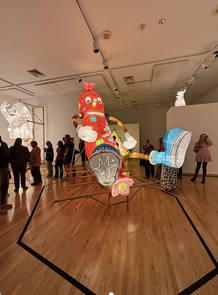
Image of the Sculpture Boots, Photo by Audrey Miller
George Ferrandi is Throwing a Party and Everyone is Invited
By Audrey Miller
Artist George Ferrandi is honoring astronomy and culture through her latest art exhibit. From Aug. 30 to Oct. 10, the Lore Degenstein Art Gallery will display Jump!Star, a collection of Nebuta sculptures, each infused with stories from communities nationwide. Ferrandi’s intergalactic initiative is to create an awareness and appreciation for our ever-changing sky, as well as start a celebration that will last for generations.
In 2015, Ferrandi started her project, Jump!Star, after learning about how Earth’s north star is dynamic due to a slight wobble in Earth’s rotation. The slight wobble, or axial precession, causes the alignment of stars above Earth’s polar axis to slowly change. During the Great Year, a 26,000-year cycle, eleven stars will interchange, serving as a cosmic compass. The name of the project is inspired by deaf American scientist, Annie Jump Cannon. Through Ferrandi’s collaboration with artists, musicians, scientists and communities nation-wide, she hopes to invent traditions and treat this cosmic miracle with the significance it deserves.
“We make such a big deal about the Earth rotating around the sun one time every year, how are we going to celebrate the transition away from Polaris?” says Ferrandi. “The star that has led ships to safe harbor for hundreds of years, led enslaved people to freedom, we want to commemorate that transition in a meaningful way, and why not start imagining what that commemoration would look like now?”
The excitement was universal at the opening night of the gallery. The public was welcomed, loud and present, at 7 p.m. The atmosphere of the Lore Degenstein Art Gallery was contagious as the connoisseurs and students alike were mesmerized by the glowing sculptures.
Ferrandi used a traditional process called Nebuta to create the sculptures. The Nebuta sculptures, derived from Japanese culture, are illuminated paper forms designed to be carried or “danced.” Their ability to be manipulated is key in the celebratory aspect.
Six out of the eleven future north stars are on display. Glowing as they were, each came with a specific story and personality. One that stood out immediately was “Boots”, a large, smiling hot dog with blue boots on. Officially named Theta Bootis, “Boots” represents a blue-white dwarf main sequence star, with a magnitude of 4.05. The star was in service during 4000 BCE and will return in 22,000 CE.
Next to each sculpture is a blurb about their origin and significance. Ferrandi associated the north star, Theta Bootis, with a happy hot dog due to its history.
“[. . .] that particular dot of light in the sky has been deemed less regal than other dots,” wrote Ferrandi. “But I think Boots should run with this. There is freedom that comes from not being taken seriously. Maybe the way to rise above your station is to float over it on our laughter.”
Community members took joy in the glowing art and ambient atmosphere. Susquehanna University student Luc Wiseley raved about their experience. Their favorite sculpture is “Ceph”, a large polar bear who is depicted talking to his Instagram followers. Wiseley walked out of this gallery with a newfound appreciation.
“Coming into this, I had no idea what the North Star even was,” said Wiseley. “But now I will look at it with a new understanding. The one we see is ours and only ours, and there will be a time where it ceases to exist.”
This is one of the many ideas Ferrandi is hoping to invoke. She wants viewers to start thinking about time and life on a grander, celestial scale.
“We are so enculturated to think as far as our grandparents and our grandchildren, which is a very small window,” says Ferrandi. “If we thought about things in more celestial time than human time, we would make such different decisions about how we use resources, how we treat each other, and what hope looks like.”
The next north star will be welcomed in 1,000 years. Gamma Cephei, represented as the previously mentioned social bear, Ceph, will be present in 4,000 CE. Till then, Ferrandi will be premiering Jump!Star at the 1708 Gallery event on Oct. 17 and 18 in Richmond, Virginia. All the sculptures will appear as well as the meals, dances and symphonies specifically designed for this project.
The exhibit will be available to the public from 11 a.m. to 5 p.m. Monday through Friday. It will close on Oct. 10. To learn more, visit www.jumpstar.love